'Recipes' Archive

Blue Cheese and Caramelised Shallot Ice Cream

Tuesday, April 29th, 2008

Blue Cheese and Caramelised Shallot Ice Cream OK - gentle readers - before you throw a tantrum, and yell “What???? Blue cheese ice cream?” I will tell you a story. A couple of weeks ago, my brother and I were discussing the book launch, when he suggested we support Irish cheesemakers by serving up some of the excellent cheeses that Ireland increasingly has to offer. I have to admit I lost the head a bit, since the idea of serving something savoury at the launch of an ice cream and dessert book simply struck me as wrong. I departed in a huff.

Wicklow Blue CheeseThe next day, however, I began thinking some more about what Sean said, especially since he usually is right. The idea of highlighting an Irish cheese or two was certainly appealing. Sean and I talked some more and decided that a cheese ice cream would make us both happy. Blue cheese, Sean suggested, might be the most interesting. I had heard about blue cheese ice cream being made in the UK, but had never tried it, and a chef we know had once suggested a cheese and caramelised shallot ice cream. So… I started playing.

I like the result, but the rest of production is split 50-50. I think it’s not something for everyone, but if you want to try something different, it might be for you.

And if you want to taste it without making it, come along to Murphys Ice Cream Killarney tomorrow evening for the book launch, or head to Dingle on Thursday. It will certainly give people something to talk about!

Murphys Blue Cheese and Caramelised Shallot Ice Cream

  • • 125g sugar (for custard)
  • • 2 tablespoons sugar (for shallots)
  • • 5 egg yolks
  • shallots• 210 ml cream
  • • 200 ml milk
  • • 150 g mild blue cheese (I used Wicklow Blue)
  • • 2 “banana” shallots, peeled
  • • 1 tablespoon butter or oil

Yield: 6 Servings 

What to do: 

  1. Quarter the shallots lengthwise and then chop into fine pieces.
  2. Fry over medium-high heat with the butter, stirring constantly until the are golden.
  3. Stir in the 2 tablespoons of sugar and continue to fry until the sugar has melted and the shallots have turned a dark golden brown.
  4. Spread on a tray to cool.
  5. Beat the rest of the sugar and egg yolks together until thick and pale yellow.
  6. Bring the milk to a low simmer.
  7. Beat the milk into the eggs and sugar in a slow stream.
  8. Pour the mixture back into the pan and place over low heat.
  9. Stir continuously until the custard thickens slightly (around 65-70C) and just coats the back of a spoon. Don’t over-heat, though, because at around 76C you will scramble the eggs!
  10. Blue CheeseImmediately remove from the heat.
  11. Allow to cool completely.
  12. Break up or chop the blue cheese and put in a blender with half of the custard - pulsing until smooth.
  13. Stir the blue cheese/custard mix back into the rest of the custard, cover, return to the refrigerator and allow to sit for at least two hours.
  14. Whip the cream until it has doubled in volume (you should have soft peaks - don’t over-whip).
  15. Fold the cream (gently stir) into the custard.
  16. Freeze using a domestic ice cream machine, adding the carmelised shallots when the ice cream is already quite solid.
  17. Otherwise, cover and place in the freezer, again adding the shallots when it has become semi-solid.
  18. If you’re using a domestic ice cream machine, transfer to a freezer-proof covered container when the ice cream has achieved a semi-solid consistency (around 15 minutes). Place it in the freezer, and continue to freeze until it is solid.

6 Servings.

Notes:

  1. Blue Cheese Ice CreamThis ice cream will only be as good as the blue cheese you use. Find one you like! 
  2. To pasteurise the eggs, heat the custard to 73C and keep at that temperature for three minutes. Use a cooking thermometer, though! If the custard goes any higher than 76C, the eggs will scramble. Immediately cover and place in the freezer until cool.

Technorati tags: , , , ,

Meringues, Take Three

Saturday, April 19th, 2008

Meringues Since I seem to be on a baking kick, I’ll post this meringue recipe. I’ve written up recipes before - most recently here, because meringues are something we want to get right. That’s because our ice cream uses only egg yolks, and we hate discarding egg whites. Meringues are also gluten-free, so they have their uses in desserts for people with restricted diets. Hopefully we’ll try to sell meringues in some form in the very near future.

Different people like meringues different ways. Some like them dry and crunchy, others like them crunchy with a somewhat chewy centre. The previous recipes have been the latter, but for making meringue baskets or using them as a base for an ice cream cake, dry is definitely better. Christophe and I have spent a few days in production testing variations in recipes and methods, and here’s our favourite.

(They need a long time in the oven, but good things come to those who wait!)

Murphys Meringues (Dry and Crunchy)

More meringuesIngredients:

  • 3 medium egg whites
  • 130 g sugar
  • 1 teaspoon lemon juice

What to Do:

  1. Preheat the oven to 100C.
  2. Beat the egg whites in a dry glass or stainless steel bowl (if using an electric mixer, do this at medium speed rather than high speed, which will take a bit longer but give the meringues more strength) until foamy.
  3. Add the lemon juice.
  4. Continue mixing until they are fairly stiff.
  5. Beat in the sugar in a slow stream.
  6. Beat until very stiff and shiny.
  7. Transfer to a piping bag (or use a couple of spoons) and shape the meringues on a baking tray or silicone mat.
  8. Bake for 90 minutes.
  9. Cool on wire racks.
  10. Meringue Close-upStore in an air-tight container.

Notes:

  1. If you want to make meringue nests, start in the centre, work out in a tight spiral, then build up the sides.
  2. Please do follow my instructions about the mixing speed. If you mix them on high, the meringues will not be as strong and could develop unsightly bubbles.
  3. There are many of things you can add to meringues in terms of flavouring - vanilla essence, almond essence, and cocoa for chocolate meringues are just a few examples. If you do add flavouring, always add it at the end, once the meringues are stiff.

Technorati tags: , , , ,

Skelligs Truffle Ice Cream

Saturday, April 5th, 2008

Chocolate Truffle Ice Cream This is one of the best flavours I think we have ever made. We’ve tried chocolate truffle ice creams before, but the question has always been what is the best base to support them? A vanilla base can be a bit bland, and a chocolate base can over-power.

This base, designed by JP and Christophe in our production, has just a whisper of chocolate - so light and delicate that it has amazed the customers in our shops over the last month or so. It complements the dark chocolate truffles perfectly.

We used vanilla ganache truffles from the Skelligs Chocolate Company, which is based right here in Kerry. We found that using mixed-flavour truffles can confuse the palate, so we ordered 7 kilos of the one kind of truffle and started chopping. They thought we were nuts, but last week Sean received a phone call of thanks from the perplexed chocolatiers. Apparently quite a few people who tasted this ice cream in our Dingle or Killarney shops, jumped in their cars and drove out to Ballinskelligs to visit the factory shop (which is now also home to Cocoa Bean) for even more indulgence!

Murphys Chocolate Truffle Ice Cream

  • Chopping chocolate truffles• 125g sugar
  • • 5 egg yolks
  • • 1/4 vanilla bean, split lengthwise or 1/4 teaspoon natural vanilla essence  
  • • 230 ml cream
  • • 200 ml milk
  • • 20 g bittersweet (70% chocolate)
  • • 100 g chopped chocolate truffles

Yield: 6 Servings 

What to do: 

  1. Melt the 70% chocolate in a double boiler over simmering water or a microwave. Take care – chocolate burns easily!
  2. Beat sugar and egg yolks together until pale yellow.
  3. Add the vanilla bean to the milk and bring to a simmer.
  4. Turn off the heat and remove the vanilla bean.
  5. Add the milk to the melted chocolate in small parts, mixing thoroughly until fully combined. 
  6. Immediately beat the milk/chocolate into the egg and sugar mixture in a slow stream. Pour the mixture back into pan and place over low heat.  Stir until the custard thickens (around 60C). 
  7. Allow the chocolate custard to cool.
  8. Whip the cream and fold into the mix.
  9. Chop the chocolate truffles into small pieces, making sure you handle them as little as possible (to avoid them melting).
  10. Truffle ice cream meltingFreeze the ice cream using a domestic ice cream machine, adding the chopped truffles once the ice cream has become semi-solid.
  11. Otherwise, cover and place in the freezer, stirring every few hours to break up the ice crystals. Again, add the chocolate truffles once it’s semi-solid (or they will sink to the bottom).

6 Servings.

Notes:

  1. This ice cream will only be as good as the chocolate you use. Find the best you can! 
  2. The boiler or container in which you melt the chocolate must be completely dry or the chocolate can clump.
  3. To pasteurise the eggs, heat the custard to 73C and keep at that temperature for three minutes. Use a cooking thermometer, though! If the custard goes any higher than 76C, the eggs will scramble. Immediately cover and place in the freezer until cool.

Technorati tags: , , , ,

Toffee Ice Cream

Friday, March 14th, 2008

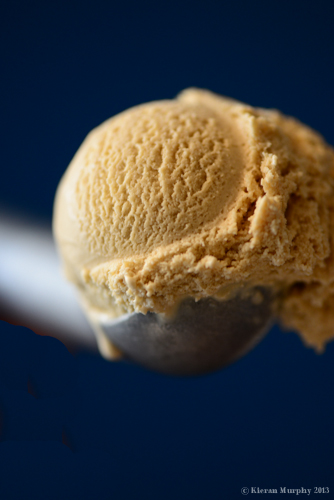
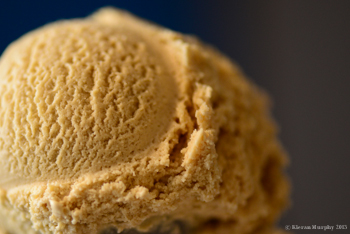
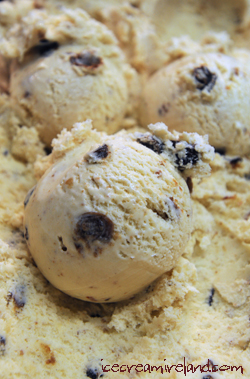
Toffee Ice Cream I grew up with toffees of various kinds - English toffees in white wrappers, salt water taffy, and toffee apples at farm fairs. Toffee is different from caramel in that it uses dark brown sugar or molasses along with butter. When put in ice cream, it makes for an unbelievably rich and sweet experience.

I like leaving big chunks of the cooled candy in the ice cream, although I have also experimented with adding the toffee while it is still warm and letting it melt into the freezing ice cream mix. It turns the finished product toffee-coloured and gives it a uniform texture and flavour that is great if you like a smooth ice cream. This recipe uses cold toffee. Just be ready - it does stick to the teeth!

MURPHYS TOFFEE (TAIFÍ) ICE CREAM

Ingredients:

  • 130g sugar
  • 5 egg yolks
  • 240 ml cream
  • 200 ml milk
  • 100 grams of toffee candy

What to do:

  1. Beat the sugar and egg yolks together until thick and pale yellow.
  2. Bring the milk to a low simmer.
  3. Beat the milk into the eggs and sugar in a slow stream.
  4. Pour the mixture back into the pan and place over low heat.
  5. Stir continuously until the custard thickens slightly (around 65-70C) and just coats the back of a spoon. Don’t over-heat, though, because at around 76C you will scramble the eggs!
  6. Immediately remove from the heat.
  7. Allow to cool completely.
  8. Break up the toffee candy into small pieces. (This might be easier if the toffee is cold!)
  9. Toffee Ice Cream CloseupWhip the cream until it has doubled in volume (you should have soft peaks - don’t over-whip).
  10. Fold the cream (gently stir) into the custard.
  11. Freeze using a domestic ice cream machine, adding the toffee when the ice cream is already quite solid.
  12. Otherwise, cover and place in the freezer, again adding the toffee when it has become semi-solid.
  13. If you’re using a domestic ice cream machine, transfer to a freezer-proof covered container when the ice cream has achieved a semi-solid consistency (around 15 minutes). Place it in the freezer, and continue to freeze until it is solid.

Note:

To pasteurise the eggs, heat the custard to 73C and maintain that temperature for at least 5 minutes. Use a cooking thermometer, though, and keep stirring! If the custard goes any higher than 76C, the eggs will scramble. Immediately cover and place in the freezer until cool.

Yield: 8 servings

Technorati tags: , , , ,

Dark Toffee

Tuesday, March 4th, 2008

Dark Toffee I’m in a sweet frame of mind, and here’s a toffee I love to munch on. It’s also used in our Toffee Ice Cream, and I’ll put up the recipe for that in due course. I always love making candy, because I find it such a miracle that sugar can transform itself so radically.

This toffee is very dark and rich, since the recipe calls for dark brown sugar, and one inevitably eats far too much of it. One can, of course, make it with light brown or even regular sugar, but I like the deep flavour of the molasses contained in dark brown sugar.

Ingredients:

  • 150 g butter
  • 200 g dark brown sugar
  • 50 ml water
  • 1 teaspoon golden syrup

What to Do:

  1. Butter a small baking dish.
  2. Combine all of the ingredients in a thick-bottomed saucepan.
  3. Stir over medium heat until the ingredients are combined.
  4. Turn up the heat and stop stirring.
  5. It will start boiling.
  6. If it starts smoking around the edges, stir gently in a circle around the edge to keep it from burning.
  7. Check if it’s ready by dropping a bit of the toffee in a cup of cold water. It should be firm but not hard to the touch.
  8. Immediately remove from the heat and pour into the buttered baking dish.
  9. Toffee CloseupAllow to cool somewhat.
  10. When it’s mostly hardened, score it with a knife to make it easier to break.
  11. Allow to cool completely, break up and enjoy!

Notes:

  1. A word of caution - caramelised sugar is very, very hot, so please take care when making this!
  2. Make sure the pan is very clean before you start. If there is residue already on the pan, it is more likely the candy will burn.
  3. The final product will have the consistency of the bit you drop into the cold water. If you like your toffee soft, take it off the heat when it forms a soft ball when dropped in the water. If you like your toffee hard, keep cooking and take it off the heat when it forms a hard ball in the water.

Technorati tags: , , , ,

Green Tea and Ginger Ice Cream

Wednesday, February 20th, 2008

Green Tea Ice Cream A reader of this blog emailed me asking for a green tea ice cream recipe, so here it is! It’s a recipe that will be in the upcoming book, and it’s one I love.

In New York, where I grew up, Asian food was part of the staple diet. Whether Japanese, Thai, Vietnamese, Chinese, or Korean, the standard was high and the variety amazing. Some of the best meals I have ever eaten were Asian cooking, and my dessert of choice, when available, was green tea ice cream.

Green TeaHere in Ireland, I have also come across green tea ice cream in some of the ever-proliferating Asian restaurants, so perhaps you have tried it as well. If so, just be aware that since we don’t believe in food colouring, we use green tea leaves (see photo right) and not the matcha (green tea powder) that is usually used for ice cream. This means that it will not be bright green and will have a slightly different taste, but I think it’s even more delicious.

For this recipe, I like to add crystallised ginger, a real favourite of mine. I love the spicy sweetness and intriguing consistency of the ginger, and since it’s coated in sugar it stays soft in the ice cream.

Murphys Green Tea and Ginger Ice Cream 

Ingredients:

  • • 130g sugar
    • 5 egg yolks
    • 240 ml cream
    • 250 ml milk
    • 2 tablespoon green tea leaves (4 bags)
    • 60 g crystallised ginger
    • 1 tablespoon honey

What to do:

  1. Heat the milk to a low simmer over medium heat.
  2. Add the tea and honey and maintain at a simmer over low heat for about 10 minutes.
  3. Remove from the heat and remove the tea bags.
  4. Beat the sugar and egg yolks together until thick and pale yellow.
  5. Beat the milky tea into the eggs and sugar in a slow stream.
  6. Pour the mixture back into the pan and place over low heat.
  7. Stir continuously until the custard thickens slightly (around 65-70C) and just coats the back of a spoon. Don’t over-heat, though, because at around 76C you will scramble the eggs!
  8. Immediately remove from the heat.
  9. Transfer the custard into a small container, cover, and refrigerate until cool (5C).
  10. Chopped GingerChop the crystallised ginger into small pieces.
  11. Whip the cream until it has doubled in volume (you should have soft peaks - don’t over-whip).
  12. Fold the cream (gently stir) into the custard.
  13. Freeze using a domestic ice cream machine, or cover and place in the freezer, stirring every few hours to break up the ice crystals.
  14. Add the ginger once the ice cream has become semi-solid.
  15. If you’re using a domestic ice cream machine, transfer to a freezer-proof covered container when the ice cream has achieved a semi-solid consistency (around 15 minutes). Place it in the freezer, and continue to freeze until it is solid.

Yield: 8 servings

Note:

To pasteurise the eggs, heat the custard to 73C and maintain that temperature for at least 5 minutes. Use a cooking thermometer, though, and keep stirring! If the custard goes any higher than 76C, the eggs will scramble. Immediately cover and place in the freezer until cool.

Technorati tags: , , , ,

Chocolate Fondue for Valentine’s

Thursday, February 14th, 2008

Chocolate and strawberry Happy Valentine’s Day!

I think there is nothing more romantic than chocolate, so what better thing to make for your loved on than chocolate fondue? There is something so sensual and luxurious about melted chocolate over fruit and other tasty items, and the very act of dipping and sharing fondue makes it special.

Raspberry in Chocolate FondueAs with all things chocolate, start with quality. Find a good, dark chocolate and there is little chance that the end product won’t be delicious.

I like a bit of Port in my chocolate fondue, especially when you’re dipping fruit. If you want even more of a kick, add an extra teaspoon!

Here’s my recipe…

Chocolate Fondue with Port

Ingredients:

    200 g 70% Chocolate
    200 ml Cream
    2 teaspoons Port

What to do:

  1. Melt the chocolate in a double boiler.
  2. Warm the cream in a saucepan to a low simmer.
  3. Amaretti dipped in chocolateRemove from the heat and stir the cream into the chocolate in small parts, stirring all the time.
  4. Chocolate and RaspberryChocolate and RaspberryThe chocolate will clump at first, then it should become smooth and glossy.
  5. Stir in the Port.
  6. Transfer to a fondue pot and enjoy!

My five favourite things to dip into chocolate fondue:

  1. Strawberries
  2. Bananas
  3. Raspberries
  4. Biscotti
  5. Amaretti biscuits

I’m sure you can think of many other delicious things to dip!

Technorati tags: , , , ,

Beghrir Moroccan Pancakes

Tuesday, February 5th, 2008

Beghrir Pancakes Today is Shrove Tuesday, and while elsewhere in the world people are dancing and singing with Mardi Gras and Carnival, here we eat pancakes. Although I’d much rather be cavorting on the streets of New Orleans or Rio, at least I can console myself with a sweet traditional meal before we head into Lent.

Two years ago at this time, I was in Morocco, and there I came across amazing pancakes called Beghrir. They are served with honey and are oddly pock-marked. Here’s a recipe, in case anyone wants a pancake that’s as tasty as it is unusual.

Beghrir

Ingredients:

  • 125 g semolina
  • 40 g non-rising flour
  • 150 ml warm water (ca 40C)
  • 150 ml milk
  • 1 egg
  • 1/2 tablespoon dried active yeast
  • 1/4 teaspoon sugar
  • Pinch of salt 

What to do:

  1. Combine the yeast with 50 ml of the warm water and the sugar. Set aside.
  2. Sieve the other dry ingredients.
  3. BeghrirWarm the rest of the water and the milk in a small saucepan to 40 C.
  4. Beat the egg well and add the warm milk and water, stirring all the time.
  5. Add to the yeast and stir until fully combined.
  6. Stir into the dry ingredients in small parts, mixing vigorously until it is combined and free of lumps.
  7. Cover and allow to rest in a warm place for 30 minutes.
  8. Warm a non-stick crepe pan or sauce pan over medium-high heat.
  9. Pour batter into the pan to make a thin, round pancake.
  10. Cook until the top layer is dry - bubbles will form.
  11. Flip the pancake and cook for another 20 seconds.
  12. That’s it! It’s ready to eat.

Yield: About 10 small pancakes. 

Note: Traditionally these would be eaten with honey mixed with butter and warmed in a pan. The ratio, if you want to try it, is 1 part butter to 4 parts honey. Simply combine them in a pan and cook over medium heat until the butter melts. Remove immediately from the heat and stir until smooth.

Technorati tags: , , , ,

Chocolate Macaroons with Cognac Ganache

Sunday, February 3rd, 2008

Chocolate Macaroon I have given a recipe for meringues here as a solution for what to do with the egg whites after making ice cream. Another possibility is macaroons. Anyone who has been to Paris is sure to have tasted these amazing confections, which rise in pyramids in bakery windows.

The following recipe is adapted from Pierre Herme, although the ganache (filling) is ours. They aren’t hard to make, although I sometimes have difficulty in getting them to rise properly (here’s a photo of a batch my brother made with a little more height). No matter. They still sure are tasty!

I like a dark cognac ganache filling, and it’s actually adaped from Wiebke’s (my brother’s wife) Sachertorte.

Ingredients:

  • 150 ml egg whites (from ca. 3 large eggs)
  • 250 g powdered sugar
  • 150 g finely ground almonds
  • 25 g unsweetened cocoa + a bit more for dusting

For the ganache filling:

  • 75 g 70% chocolate
  • 25 g butter
  • 50 g golden syrup
  • 1 teaspoon cognac

What to do:

  1. Pre-heat the oven at 150C.
  2. Beat the egg whites until soft peaks form (don’t over-whip!)
  3. Sift together all the dry ingredients.
  4. Fold into the egg whites in four additions.
  5. Put a teflon baking mat on the counter, or put a teflon liner (cheap and reusable and should be available at any supermarket) on a baking tray.
  6. Spoon the dough into a piping bag and pipe out half inch to one inch round circles on the baking tray, leaving 1 inch of space around each cookie for them to expand. You can also simply use a spoon.
  7. Try to keep the size of them the same, since you will be using two to make the filled macaroons. I like them small.
  8. Dust with cocoa. 
  9. Macaroon CloserBake for 8-10 minutes, until the cookies are firm but still pliable.
  10. Place on baking racks to cool.
  11. For the ganache filling, melt the chocolate and butter in a double boiler over (not touching) simmering water.
  12. Remove from the heat and stir in the golden syrup.
  13. Stir in the cognac.
  14. Allow to cool until it is semi-solid, and then either pipe or spoon onto the flat side of a cookie.
  15. Top with a second cookie.
  16. Allow to set before serving, if you have that kind of patience!

Technorati tags: , , ,

Orange Jaffa (Oráiste) Ice Cream

Wednesday, January 30th, 2008

Orange Jaffa Ice Cream This was one of our very first ice cream formulations and has proven very popular of the the years. In fact, there is a certain little girl whose first word was reportedly “Jaffa” when demanding this flavour from her parents. It’s a crowd-pleaser, with shredded bits of Jaffa cakes as well as another British invention - marmalade.

Marmalade goes way back (the Oxford English Dictionary cites 1480 as the first usage of the word) and is generally made with citrus fruits - orange being the most popular option. As citrus fruits became more available in Britain in the 16th century, marmalade became a choice sweet. In fact, anyone who has travelled in the UK will be hard put upon to remember a traditional breakfast without the option of these preserves and toast.

We like to use the marmalade as a base flavour and freshen it with orange zest. The great thing about orange zest (besides its magnificent taste) is that it uses a part of the fruit one would normally just throw away or compost, and that always is a pleasure.

ORANGE JAFFA (ORÁISTE) ICE CREAM

Ingredients:

  • Jaffa Cakes130g sugar
  • 5 egg yolks
  • 240 ml cream
  • 200 ml milk
  • Zest (grated peel) of half an orange
  • 50 g marmalade
  • 4 Jaffa cakes

What to do:

  1. Add the orange zest to the milk and bring to a simmer.
  2. Remove from the heat.
  3. Beat the sugar and egg yolks together until thick and pale yellow.
  4. Beat the milk into the eggs and sugar in a slow stream.
  5. Pour the mixture back into the pan, and place over low heat.
  6. Stir continuously until the custard thickens slightly (around 65-70C) and just coats the back of a spoon. Don’t over-heat, though, because at around 76C you will scramble the eggs!
  7. Immediately remove from the heat. Sieve if you want to remove the orange zest.
  8. Stir in the marmalade.
  9. Transfer the custard into a small container, cover, and refrigerate until cool (5C).
  10. Whip the cream until it has doubled in volume (you should have soft peaks - don’t over-whip).
  11. Fold the cream (gently stir) into the custard.
  12. Shred the jaffa cakes into small pieces.
  13. Freeze using a domestic ice cream machine, adding the jaffa cakes when it’s semi-solid. You can also just cover and place in the freezer, stirring every few hours, and again, add the jaffa cakes when it’s semi-solid.
  14. If you’re using a domestic ice cream machine, transfer to a freezer-proof covered container when the ice cream has achieved a semi-solid consistency (around 15 minutes). Place it in the freezer, and continue to freeze until it is solid.

Note: To pasteurise the eggs, heat the custard to 73C and maintain that temperature for at least 5 minutes. Use a cooking thermometer, though! If the custard goes any higher than 76C, the eggs will scramble. Immediately cover and place in the freezer until cool.

Technorati tags: , , , ,